|
 |
|
 |
|
|
|
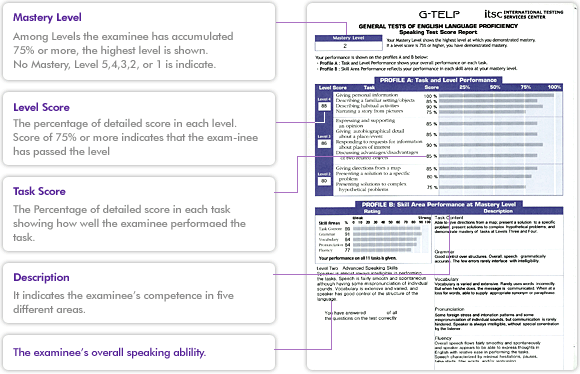
| Each examinee receives a Score Report that is parallel to the Score Report of the written G-TELP. This summary of performance provides several scores: the Mastery Level; Level Scores for each of the three levels (Two, Three, Four); percentage profiles indicating performance on each task; and evaluations of performance on the Skill Areas (Content, Grammar, Vocabulary, Pronunciation, Fluency) across all 11 tasks, including a description of Skill Area Performance at the examinee's level of Mastery. |
|
|
| Grammar |
The speaker's control of basic sentence structures |
|
| Vocabulary |
The speaker's available vocabulary in the performance of certain required speaking tasks |
|
| Pronunciation |
The speaker's control over sound production |
|
| Fluency |
The speaker's flow of speech and degree of spontaneity as well as facility in the performance of the required tasks |
|
| Content |
The topics/contexts on which the speaker can speak about |
|
|
|
| The Overall Evaluation, which confirms the examinee's Mastery Level, is based on comprehensibility, which is a more general assessment of the speaker's communicative ability, influenced to some extent by the other, separately evaluated, skills. |
|
| The performance of the examinees is evaluated by local experts in English as a foreign language, who have been trained and certified by G-TELP Services to consistently assign objective and accurate scores to in-country nonnative speakers of English. |
|
| Examinees and score users receive a Score Report that is parallel to the Score Report of the G-TELP. This summary of performance includes several scores. |
|
 |
The level of mastery; |
|
|
Separate level scores for each of the three levels; |
|
|
Percentage profiles summarizing the performances on each task; |
|
|
Evaluations of the performances in the five Skill Areas across all 11 tasks: Content, Grammar, Vocabulary, Pronunciation, Fluency, and Interaction; |
|
|
Descriptions of the Skill Area Performance at the examinee's level of mastery. |
|
|
 |
|